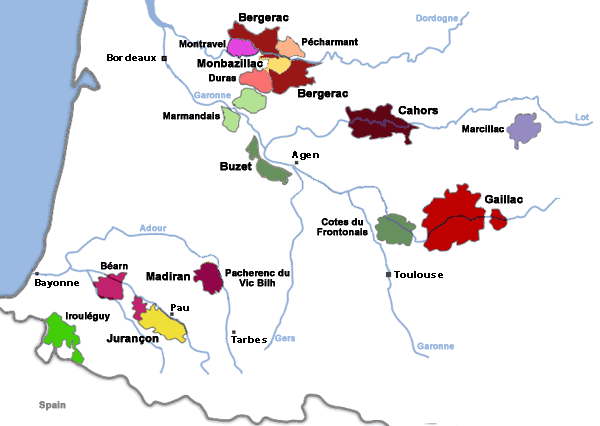
Location: From the edge of the Bordeaux region to the Pyrénées mountains Main Cities: Toulouse, Tarbes, Albi
Vineyards cover 16,000 hectares (40,000 acres) with 6,000 winemakers.
Annual wine production of over 270 million bottles (88% red wine - 7% dry white wine - 3% rosé - 2% sweet white wine).
From the banks of the Garonne to the valley of the Lot, passing through the Pyrénées and the Gascogne regions, the vineyards of the South-West showcase a wide variety of terroirs and wines. Due to the prominence of their next door neighbor, Bordeaux , and the similarity of soil, climate and location, this area generally features the same varietals and styles of wine as Bordeaux.
Despite the range of soils, climates and grape varieties, the wines do seem to have a recognizable style. The reds have a rich, dark color and a certain rusticity, rather hard when young but age well. Typical of this style are the wines of madiran and Cahors with their exceptional robustness. Legend has it that putting a drop of the "black wine of Cahors" to the lips of a dead man would bring him back to life. Cahors is the original home of the great Malbec grape - a brawny, broad-shouldered wine. These wines are among the few that can handle game - venison, boar, etc.
The Well-known AOCs : Bergerac, Cahors (Malbec), Madiran (Tannat), Monbazillac, Montravel, Pecharmant. Cahors is noteworthy because its wines are entirely Malbec. Madiran is among the few in the world to use the Tannat grape.
Red and rosé: Cabernet Sauvignon, Cabernet Franc, Merlot, Côt (Malbec); White: Sémillon, Sauvignon, Muscadelle, Ondenc, Chenin Blanc
Type of Wine
Aromatic red wine, Fresh and fruity rosé, Dry white wine
Age
Red: 2 to 4 years; White and rosé: drink young
Vintages
2006, 2005, 2004
Aromas
Black fruits, Red fruits, Vanilla
Food
Red: Roasted chicken, Coq au vin; White: Fish
Cheese
Red: Rocamadour, Mozzarella; White: Cabécou
The red, aromatic and generous wine of Bergerac is coming from a mixture of diverse grapes juice. There are the so-called noble grapes (Cabernet Sauvignon, Merlot) and the more traditional grapes (Côt, Fer, Mérille). The rosé wine in Bergerac is fresh and fruity, it comes primarily from Cabernet. The white Bergerac is dry and nervous. It is recommended to wait two years before tasting a white wine from Bergerac.
BUZET
Name
Appellation Buzet Controlée
Location
South of Pau and East of Agen cities
Places
27 villages: Buzet sur Baise, Nérac, Sainte Colombe en Bruilhois, etc
History traces back wine in Buzet to the roman time. But it was during the middle-age that Buzet got a reputation. At that time, the vineyards belong to the Bordeaux wine region. Actually, Buzet wines come from grape varieties from the Bordeaux region: Cabernet Sauvignon and Merlot. Red wine counts for 90% of the production. Red wine is powerful and meaty. It can be compared with Haut Médoc wine from Bordeaux. Do not confuse Buzet in the South West of France with Buzet in Croatia!
CAHORS
Name
Appellation Cahors Controlée
Location
Around Cahors city on both banks of the Lot river
Places
Vire sur Lot, Soturac, Prayssac, etc
Soil
Limestone
Size
4,200 ha (10,300 acres)
Production
30 million bottles (Red wine only)
Grapes
Côt (also called Malbec), Merlot, Tannat
Type of Wine
Robust red wine
Age
3 to 10 years
Vintages
2006, 2005, 2000
Aromas
Spices, Coffee, Black fruits
Food
Cassoulet, Mushrooms, Couscous, Duck or goose confit
Cheese
Bleu d'Auvergne, Caussedou
Cahors wine is harvested in the Lot and in the Bergerac, around the good-town of Cahors. It is one of the oldest vineyards in France. Cahors is a powerful red wine, often harsh when young but remarkable after a few years in bottle.
GAILLAC
Name
Appellation Gaillac Controlée, Appellation Premières Cotes de Gaillac Controlée, Appellation Gaillac Mousseux Controlée
Location
In the Tarn district, west of Albi city
Places
73 villages
Soil
Clayey limestone, Gravels
Size
2,500 ha (6,200 acres)
Production
10 million bottles
Grapes
Red: Duras, Fer, Syrah, Cabernet; White: Len de l'el, Mauzac, Muscadelle; Rosé: Mauzac
Type of Wine
Rustic red wine, Aromatic white wine, Rich sweet wine, Fruity sparkling wine, Light rosé wine
First vines were planted in Gaillac during the roman time. A sparkling wine from Gaillac was very famous in the middle-age. Wine growers still use traditional grape varieties such as Ondenc, Len de l'el and Mauzac in white, Fer, Duras and Braucol in red. They also use typical grapes from Bordeaux such as Cabernet, Merlot and Sauvignon, and from the south such as Syrah and Muscadelle. The large variety of grapes explains the diversity of Gaillac wines. Red wines are rustic. White wines are usually dry and aromatic. Sweet wines from Premières Cotes de Gaillac are rich and suave. Sparkling wines are fruity. Rosé wines are light and easy to drink.
JURANCON
Name
Appellation Jurançon Controlée
Location
South of Pau city in the western part of Pyrénées mountains
Places
25 villages: Monein, Jurançon, Gan, etc
Soil
Clay, Limestone, Pebbles (coming from the mountains)
Size
750 ha (1,850 acres)
Production
4.5 million bottles (Dry white: 75%)
Grapes
Gros Manseng, Petit Manseng, Courbu, Camaralet de Lasseube, Lauzet
Type of Wine
Sweet white wine, Dry white wine
Age
Dry: 2 to 4 years; Sweet: 5 to 20 years and more
Vintages
Sweet: 2006, 2004, 2000, 1997, 1996, 1995
Aromas
Dry: Honey; Sweet: Pineapple, Cinnamon
Food
Dry: Trout or Salmon, White meat; Sweet: Foie gras
Jurançon acquired its celebrity while being used for the baptism of King Henri IV. The vines grow on steep slopes such as in Hermitage, undergoing both oceanic and mountainous climates. The vine growers use traditional grapes such as Lauzet, Petit and Grand Mansengs and Courbu. Sweet Jurançon is a golden wine with exotic fruits and honey aromas. It can age for a very long time. Dry Jurançon has a color drawing towards clear green. The blanc de blanc (white from white) is a fresh and aromatic dry wine. Dry Jurançon accounts for 75 % of the total wine production in Jurançon.
MADIRAN
Name
Appellation Madiran Controlée, Appellation Pacherenc du Vic Bilh Controlée (in the same production area as Madiran)
Location
Facing the Pyrénées mountains
Places
Maumusson, Aydie, Viella, etc
Soil
Clayey-limestone
Size
1,300 ha (3,200 acres)
Production
10 million bottles (Red wine only)
Grapes
Tannat (at least 40%), Cabernet Franc, Cabernet Sauvignon, Fer Servadou
Type of Wine
Full body red wine
Age
4 to 8 years and more
Vintages
2005, 2004, 2001, 2000
Aromas
Black fruits, Spices, Grilled bread
Food
Cassoulet, Roasted duck, Duck or goose confit
Cheese
Roquefort, Bleu d'Auvergne, Ossau Iraty, Chaumes
Right in the middle of a region which only produces white wine (St Mont, Pacherenc, Jurançon), Madiran is a sanctuary for red wine. The vine growers in Madiran produce a red wine dotted of a particular character. It is elaborated from quality grape-varieties such as Cabernet Sauvignon & Franc. But the most popular variety is Tannat, a typical grape from the area. Madiran is a rough wine when young. After a few years in a cellar, it turns into a sensual and tannic wine.
MONBAZILLAC
Name
Appellation Monbazillac Controlée
Location
In the Dordogne valley, south of Bergerac
Places
Monbazillac, Rouffignac, Pomport, Colombier
Soil
Clayey limestone
Size
2,200 ha (5,400 acres)
Production
6.5 million bottles
Grapes
Sémillon, Sauvignon, Muscadelle
Type of Wine
Sweet viscous white wine
Age
5 to 30 years and more (can age over 60 years)
Vintages
2006, 2005, 2000, 1997, 1996, 1995, 1990
Aromas
Honey, Vanilla, Apricot, Orange
Food
Foie gras, Aperitif
Cheese
Roquefort, Bleu d'Auvergne, Fourme d'Ambert
Among the best sweet wines in France, Monbazillac (or Montbazillac) must wait for noble-rot to attack the grapes before being harvested. In good years Monbazillac wines can compete with the models of the type such as Sauternes and Barsac. Monbazillac are very attractive sweet wines. They flow like gold in your throat. With age their color intensifies and they develop their rich and intense characteristics.












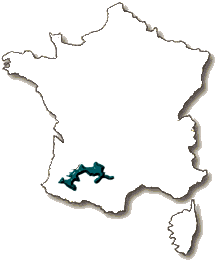 Location: From the edge of the Bordeaux region to the Pyrénées mountains